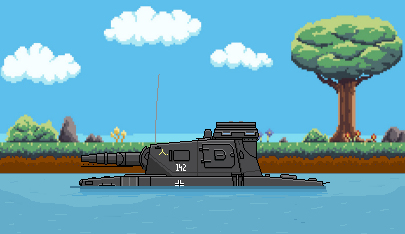
- PzKpfw IV Ausf. D
- river Maas, near Dinant, Belgium
- May 13th, 1940
- 2. Abt, 31. PR, 5. PD
- Leutnant Heinz Zobel
Panzer of the Lake

If you've looked at the Internet in the last, oh, thirty years, you may have noticed memes. Usually, they're little particles of (questionably) funny information on a template picture, traditionally using Impact font. One of these is known as "Panzer of the Lake", which sounds rather Arthurian.
King Arthur: The Lady of the Lake, her arm clad in the purest shimmering samite, held aloft Excalibur from the bosom of the water, signifying by divine providence that I, Arthur, was to carry Excalibur. THAT is why I am your king! Dennis: Listen; Strange women lying in ponds distributing swords is no basis for a system of government! Supreme executive power derives from a mandate from the masses, not from some farcical aquatic ceremony! (Ow! Ow! I'm being repressed!)
I love that movie. "You mother was a hamster, and your father smelled of elderberries!" Anyway, we have a funny picture of a Panzer in a Lake. But: which Panzer? Which lake? Fortunately, Schwern at History Stack Exchange did extensive research and came up with what I do think is the correct answer. However, if you know better, talk to ConeOfArc on Discord for a $100 reward and we'll be equally happy.
How not to cross a river
Two days into Fall Gelb, the 5th Panzer Division was barreling through Belgium toward the river Maas. Rivers need crossing, and in 1940 that meant finding a bridge before someone blew it up. There are only so many points where you can cross that river - steep banks and cliff formations - so the Germans were naturally funneled towards the area between Namur and Dinant, where the Belgian army was hard at work destroying the bridges, blocking the German advance. However, Oberst Paul Werner, commanding the 31st Panzer Regiment, got word from Luftwaffe reconnaissance that the bridge at Yvoir was still intact. He didn't call corps headquarters. He didn't wait for someone to tell him what to do. Instead, he ordered Leutnant Heinz Zobel to take his platoon of Panzers and two armored scout cars, and to get to that bridge at top speed. That was the job. How Zobel did, that was his problem. To civilians, this may seem callous or uninterested - it is not. Oberst Werner trusted his men and their ability to get things done. Zobel had complete freedom to act as he needed, and he knew that he did. This is called Auftragstaktik, where a leader relies on the ability of his people to get things done.
Now, that bridge. It was still there, because civilians were crossing it and the Belgian army did not want to kill their innocent countrymen, or to block their escape. Nevertheless, the bridge was mined and Belgian Lieutenant de Wispelaere and his men were waiting. He had his hand on the detonator. When Zobel's scout cars came into view and the shooting started, de Wispelaere pushed the electrical ignition. Nothing happened. He left his shelter, found the manual backup, and pushed it. A German machine gun caught him as he tried to get back to his bunker. He fell - but he'd already pushed the plunger. The bridge came down in a cloud of dust and smoke. De Wispelaere died doing exactly what needed doing, and left Zobel with a smoking rubble heap and no way across.
A bridge around the corner
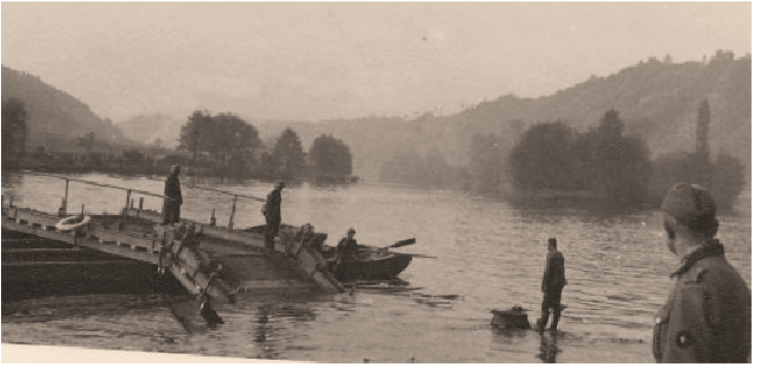
The German advance stalled at Yvoir. But a few kilometers south, near the village of Houx, engineers found something useful: just to the south of a lock gate, the river banks were shallow and the water flowed slow. This was an ideal place for a pontoon bridge, so the pioneers got to work. However, Rommel and his 7th Panzer Division had also been funneled to this area, and he did not like waiting. He wanted to get his forces across before the pontoon bridge was finished; a good idea, because a bridgehead needs defending. So when he saw engineers using a section of pontoon bridge as a ferry for anti-tank guns, he ordered two sections bolted together to carry a panzer across. The homebrew ferry was rated for sixteen tonnes. The Panzer IV Ausf. D weighs twenty-five. Leutnant Zobel carefully drove his tank on the float. Engineers, already on the west bank via the lock gate, carefully dragged it across with ropes. And as Schwern describes it so eloquently, "approaching the shore, the ferry lifts, the load shifts, and the tank falls into the river." Wondering what to do, a German Pionier in his off-white Drillich fatigues stood looking at the scene, when the legendary meme photo was taken.
The thing about Erwin
I mentioned a thing called Auftragstaktik - mission tactics. This was the German way of doing things in 1940, and the idea is now widely used by professional armies and capable business leaders. You get an objective from your leader, you get some resources, and you're expected to figure out the rest yourself. You do not radio back to ask if it's a good idea. You do not wait for permission. You go, and do what's needed. Werner didn't ask HQ if he could send Zobel. Zobel didn't ask before looking for an alternative way to cross crossing. Rommel didn't ask if he could cross at Houx. Actually, he did, and Hoth - the corps commander - had explicitly forbidden him from crossing on his own initiative. Rommel ignored him and crossed anyway, and by the time Hoth found out, there was a bridgehead.
That's the system working as designed. Initiative at every level, decisions pushed down to the man who can see the ground. De Wispelaere understood this too, in his own way. He didn't wait for orders when the electrical circuit failed. He went and destroyed the bridge. The only moment in this whole story where nobody stopped to ask whether something was a good idea - not in a heroic way, just in a basic physical sense - was when a twenty-five tonne tank was loaded onto a sixteen-tonne ferry. The same culture of "get it done" that punched through the Ardennes and wrong-footed the entire Allied high command also put a perfectly good Panzer IV on the bottom of the Maas.